
The Ten Seconds Before You Help
Observe. Wait. Try. Connect. — the four small steps behind thinking-first parenting

My son was doing a puzzle last week and one piece would not go in. He turned it, pressed it, turned it again. I watched his face start to tighten, and I felt my hand move toward the piece before I had decided anything.
That’s the moment I keep writing about. Not the puzzle. The hand.
Because I know exactly what happens next if I let it finish the journey. I fix the piece. The puzzle gets done. And the most interesting thing happening at that table — a three-year-old running experiments — quietly ends.
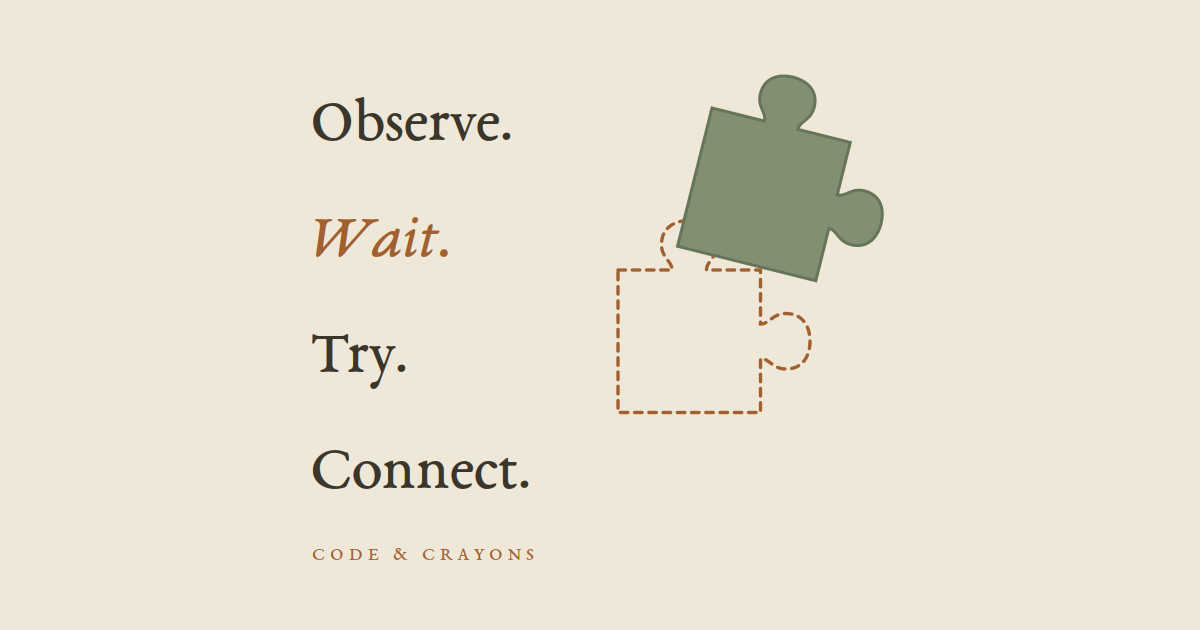
I’m a software developer, so I think in systems, and for a long time I assumed thinking-first parenting meant building a better system. More curated books. Better activities. Smarter questions. It doesn’t. The activities in our house are embarrassingly ordinary: puzzles, blocks, the same five books, a memory game we’ve played two hundred times.
What changed wasn’t what we do. It’s what I do in the ten seconds before I react.
I’ve boiled it down to four small steps. Observe. Wait. Try. Connect. Not a method. More like a checklist I run before I teach, fix, praise, explain, or interrupt.
Observe
Advice given before observation is usually advice for a different child.
When my son says “I can’t,” I used to hear one thing: a request for help. Now I look first. Sometimes “I can’t” means this is genuinely too hard. Sometimes it means I’m tired. Sometimes it means stay close while I try again. Those are three different sentences wearing the same words and they need three different parents.
Same with play. A child dropping the same car down the same ramp for the ninth time looks stuck. Watch closely and you’ll usually find a variable changing — the angle, the speed, which hand. That’s not repetition. That’s testing.
Same with books. Rereading isn’t a rut. It’s a child moving from what happens to how it works. The tenth read is where they start predicting, correcting you when you skip a word, noticing the picture in the corner.
Observation is just this: before you respond, spend ten seconds finding out what is actually happening. Most of the time, it’s not what it looks like.
Wait
This is the hardest one, so I’ll be honest about why: waiting feels like doing nothing and doing nothing feels like bad parenting. It isn’t. The pause is where the thinking lives.
When a child is mid-struggle with a puzzle piece, their brain is doing exactly the work we say we want — holding a goal, testing an approach, tolerating not-yet. Help offered too early doesn’t shorten the struggle. It deletes it.
So I wait. Not forever. Often just to a slow count of ten.
After he loses a game, I wait before the pep talk. The disappointment needs a few seconds to exist before it can be worked through. Rushing in with “it’s just a game!” doesn’t teach losing gracefully. Sitting quietly next to a child while the feeling passes through — that teaches it.
When he says “I’m bored,” I wait longest of all. Boredom announced is almost never boredom final. It’s the awkward hallway between activities, and if I don’t fill it, he usually does — and what he fills it with is more interesting than anything I would have suggested.
The pause is not neglect. It’s the space where a child discovers they had a next move.
Try
Waiting doesn’t mean never helping. It means when you do step in, you offer one small next step instead of the whole solution.
The difference is who stays in charge of the problem. “Here, like this” takes the problem away. A small next step hands it back with a little momentum.
The phrases I actually use:
“Show me the part that’s not working.”
“Try turning it once.”
“What happens now?”
“Can you start with this?”
“Show me what you tried”
Notice none of these contain the answer. They contain a direction. The child does the last step themselves — and the last step is the one that gets remembered as I did it.
This took practice for me, because my job is literally solving problems efficiently. Efficiency is the wrong metric here. The goal is not a finished puzzle. The goal is a child who knows what to do with an unfinished one.
Connect
The fourth step happens mostly in your own head and it’s the one that makes the other three sustainable.
Connect means naming, quietly to yourself, the deeper skill inside the ordinary moment. The puzzle isn’t about the puzzle — it’s attention and error correction. Losing the game isn’t about the game — it’s emotional stamina, the ability to feel a hard thing and stay at the table. The rereading isn’t a rut — it’s the exact mechanism early reading is built from. The repeated toy isn’t a lack of imagination — it’s an experiment being run to completion.
Once you can see the skill under the surface, the boring moments stop being boring. You stop feeling pressure to upgrade the activity, because you can see the activity is already working.
What it looks like in practice
“I can’t.” Observe: is this too hard, or too tiring, or a bid for company? Wait: don’t fill the silence yet. Try: “Show me the part that’s not working.” Connect: he’s learning that stuck is a place you can work from, not the end of the road.
Losing a game. Observe: real tears or performance? Wait: let the feeling arrive before the lesson. Try: “Want to play again, or should we look at what happened?” Connect: this is emotional stamina being built, one small loss at a time.
Rereading the same book. Observe: what is he doing differently on this read? Wait: resist offering a new book. Try: “What happens next?” and let him tell you. Connect: repetition is where decoding, prediction, and confidence come from.
The same toy, again. Observe: find the variable he’s changing. Wait: don’t rotate the toys yet. Try: “What happens if it goes faster?” Connect: he’s practising the full loop — question, test, result — which is the whole of thinking in miniature.
None of this requires new materials, more time, or a calmer house than the one you have. It requires ten seconds and a different reflex.
I’ll be writing more this month about where this instinct to jump in comes from — mine has a very specific origin, and it involves thirteen years of fixing things for a living. But that’s for another Monday.
Sometimes the most useful parenting shift is not doing more. It is noticing more before we interrupt the thinking.
I think parents rush in to rescue because we ourselves can't stand tension of watching our kids struggle. It's not that they can't self sooth, it's that we can't.