
The Skill We Steal When We Keep Children Busy

The problem is not boredom
I don’t think the real problem is that children are not bored enough. That conversation has already been had. “Let children be bored” has become one of those parenting lines we all nod at, even while secretly searching for five rainy-day activities at 7:42 in the morning.
But I think there is a deeper problem hiding underneath the boredom conversation. When we keep children busy all the time, we may not only be removing boredom. We may be removing their practice in beginning.
That is the skill I worry about. Not boredom itself. Initiation.
The ability to look at an empty moment and slowly find a way in. The ability to start without being handed a full plan. The ability to turn “nothing is happening” into “I can do something with this.”
That is very different from being occupied.
Busy is not the same as engaged
A child can be busy all day and still not know how to begin. They can move from activity to activity, toy to toy, class to class, screen to screen, and still depend on someone else to provide the next input.
The next idea. The next setup. The next instruction. The next rescue from the discomfort of an empty space.
When that happens often enough, the child may stop asking, “What can I make of this?” and start asking, “What are you giving me now?”
That is the shift I find uncomfortable.
Because a busy child is not always an engaged child. Busy can be external. Engagement has to be entered. Busy can be supplied. Engagement has to be activated. Busy can keep a child occupied. Engagement helps a child meet their own mind.
This is why I think we need to be careful with the modern obsession around keeping children busy. It sounds loving. It sounds responsible. It sounds like we are providing a rich childhood. But sometimes, without meaning to, we become the operating system of our child’s play.
We decide the activity. We set the goal. We create the rules. We solve the boredom. We move them to the next thing before they have had the chance to start anything from inside themselves.
And then we wonder why they struggle with empty time.
Of course they do.
Empty time is not empty for a child who knows how to enter it. But for a child who is always supplied with the next thing, empty time can feel like a blank screen waiting for someone else to press play.
Why unstructured play matters
That is why unstructured play matters. Not because it looks impressive. It usually does not.
It can look like wandering. Repeating. Moving things from one place to another. Turning a cushion into a mountain, then a boat, then a shop counter. Making strange sounds with a toy car for twelve minutes. Building something, breaking it, then rebuilding it with one unnecessary rule that only makes sense to the child.
From the outside, it may look like nothing much. But inside, the child is doing the work of initiation.
They are choosing, testing, changing, waiting, returning, inventing, and staying. Sometimes, before all of that, they are simply feeling the discomfort of not knowing what to do next.
That discomfort is not always a problem to fix. Sometimes it is the doorway.
If we fill the doorway too quickly, the child never gets to cross it.
The book that helped us see “nothing” differently
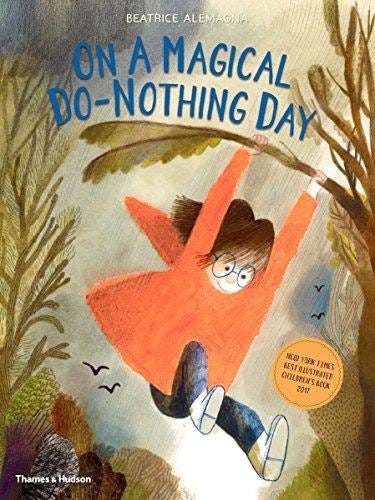
One book helped me see this more clearly at home: On a Magical Do-Nothing Day by Beatrice Alemagna.
We have read it again and again. On the surface, it looks like a book about boredom. A child is stuck on a rainy day, wants the screen, and is not happy when that easy escape disappears.
But what happens after that is the important part. The child goes outside unwillingly at first, and then slowly begins to notice the world: mud, rain, snails, stones, trees, small movements, small textures, small discoveries.
The “nothing” day is not empty at all. It is full of noticing. Full of movement. Full of sensory attention. Full of a child moving from external input to internal initiation.
And yesterday, my son said something that captured the whole book better than any adult summary could.
He said, “It’s not a magical do-nothing day. It’s a magical do-something day.”
Because the girl was doing so many things.
Exactly.
That is the point we often miss. The goal is not to make children do nothing. The goal is to give them enough space to start doing something that comes from them.
Looking at mud. Following a snail. Making a path. Inventing a rule. Turning a rainy day into a world.
That is not passivity. That is agency.
Why this matters even more now
Agency matters more than busyness, especially now. Our children are growing up in a world where there will always be another input ready for them: another video, another app, another generated story, another answer, another prompt, another feed, another tool that can begin for them.
So perhaps one of the most important childhood skills will be the ability to begin without being fed the beginning. Can a child stay with a quiet moment before outsourcing it? Can they make something from what is already here? Can they move from “I don’t know what to do” to “Let me try something”?
That starts much earlier than we think. It starts when a child says, “I’m bored,” and we do not immediately panic. It starts when we offer a small doorway, not a full entertainment program. It starts when we leave a few open materials visible and do not over-explain them. It starts when we let repetition continue instead of interrupting it because it does not look productive. And it starts when we stop measuring the day by how busy the child was, and start noticing how deeply they entered something.
What to do instead
So maybe the better question is not, “How do I keep my child busy?” Maybe the better question is, “How do I help my child begin?” That question changes the goal. We are not trying to fill every empty moment; we are trying to give the child enough support to enter the moment themselves.
1. Pause before filling the gap
When your child says, “I’m bored,” try not to rush into activity mode immediately. You can say, “Bored is okay for a few minutes. Sometimes an idea comes after that.”
2. Offer a doorway, not a full plan
When your child keeps asking, “What should I do?”, give a small starting point. “You can start with the blocks or the animals. I’ll come back in ten minutes to see what happened.”
3. Reduce the noise
When your child has many toys but touches none of them, reduce the choice. Put out only two open-ended things, like blocks and animals, cars and tape, books and soft toys, or paper and crayons.
4. Use connection as a bridge
When your child wants you to play but you cannot fully join, start with a few minutes of connection. “I can build the first house with you, and then you make the road while I cook.”
5. Help without rescuing
When your child gets stuck, try not to solve too quickly. Ask, “Show me what you tried first,” or “Do you want a clue, or more time?”
6. Stretch repetition, don’t interrupt it
When your child repeats the same play, resist the urge to upgrade it immediately. Add one small rule if needed: “Can the car reach the garage without touching the blue road?”
7. Leave one quiet invitation
When nothing is happening, leave one simple thing visible. A cardboard box, two books, animals beside blocks, paper and crayons, or cushions near the sofa can be enough.
The shift is small, but important. We are not trying to keep the child busy. We are trying to help the child enter something. A busy child is moved from one thing to another; an engaged child slowly learns how to begin, continue, change direction, and make something from what is already there.
A note about babies and young toddlers
Of course, this looks different with a one-year-old or a young two-year-old.
A toddler cannot be expected to manage long empty stretches alone. They need more adult presence, safer boundaries, simpler choices, and activities that protect them from danger while we cook, work, or breathe for two minutes.
So yes, sometimes we do need to keep a toddler safely occupied.
A basket of scarves, water play, stacking cups, board books, blocks, pots and spoons, or a few animals on the floor can be exactly what they need.
But even then, I think the deeper question remains the same.
Am I only trying to fill time?
Or am I offering something they can enter, repeat, explore, and slowly make their own?
For a one-year-old, engagement may look like dropping the same spoon twenty times. For a two-year-old, it may look like pouring water from one cup to another again and again. For a three-year-old, it may become pretend play, rules, puzzles, stories, and small problem-solving.
The form changes with age, but the direction stays the same. At one, we may offer safe occupation. At two, we may offer simple repetition. At three and four, we slowly offer more space for self-led play, rules, stories, and small problem-solving.
So no, the answer is not to stop helping children. The answer is to notice what kind of help we are giving. Are we filling every empty space for them, or are we gently helping them enter it?
That is the difference I want to remember.
Because the goal is not a child who is busy every minute. The goal is a child who can slowly move from being occupied by us to becoming engaged from within.
A child who can begin.
And maybe that is one of the quietest but most important skills we can protect.
i love these tips! will be helpful for parents who are unsure where to start if their kids need some nudging in unstructured play.
I feel this so deeply! My kids are not being shuffled to after school activities every week day. There is also no screens on weekdays. It was hard at first, but they have mastered the joy of "doing nothing". Mastered because they just have to figure it out. With the toys and games we have at home. With playing in the park when its nice. Its so much easier in the short term to have them over scheduled, or with screens. But the gift you give them of initiating activities when bored is priceless.