
Obedience Looks Impressive. Thinking Looks Messier.
Why the traits adults reward most in young children are not always the ones that matter most for the future.

There is a kind of child the world rewards very early.
The child who sits quietly.
The child who follows the instruction the first time.
The child who does not interrupt.
The child who does not complicate things.
The child adults describe as “so good.”
And there is a kind of parenting that gets rewarded too. The kind that produces a child who is easy to manage in public, pleasant in groups, quick to comply.
Sometimes that does reflect real security, guidance, and maturity.
But not always.
Sometimes it simply reflects a child who has learned that approval comes fastest when they stay inside the line adults prefer.
That is why I keep coming back to a question I think matters more than whether a child is easy to handle:
Is this child only learning to behave well, or also learning to think well?
Because those are not the same thing.
The confusion between “good” and “thinking”
We collapse too many things into the word good.
Quiet becomes good.
Easy becomes good.
Compliant becomes good.
Agreeable becomes good.
But a well-behaved child is not automatically a thinking child.
A child can follow instructions beautifully and still not learn how to question. A child can memorize quickly and still not know how to make sense of what they are hearing. A child can look calm, polished and impressive, while slowly learning that their job is to give the expected answer, not form an original thought.
That may work for a while. In fact, it often looks very successful in early childhood.
But it is a fragile kind of success.
Because the world our children are growing into will not reward neat compliance the way adults still do. It will reward judgment. Curiosity. Flexibility. Discernment. The ability to notice when something sounds polished but is wrong. The ability to ask better questions when answers are available everywhere.
And that kind of mind does not always look tidy in childhood.
Thinking often looks inconvenient first
This is the part adults do not like to admit.
We say we want children who are curious, independent, creative, confident. But when those traits appear in real life, they are often inconvenient.
Curiosity asks too many questions.
Independence resists help.
Creativity ignores the intended use of the toy.
Confidence pushes back.
Observation notices our inconsistencies.
In theory, we admire these qualities.
In practice, we often prefer the smoother child. The child who says “okay” quickly. The child who follows the activity card. The child who does not wander off-script. The child who does not force us to rethink what we just said.
But a child who is learning to think will often do exactly that. He will go off-script. He will ask why again. He will come up with a version that makes less sense to the adult and more sense to him. He will use the material wrongly according to the box but meaningfully according to his own mind.
That is not always defiance. Sometimes it is cognition.
And that distinction matters.
I see this most clearly in ordinary moments at home
I notice this all the time with my son, especially in play.
I have seen how quickly adults can mistake non-compliance for lack of focus, when actually the child is deeply engaged, just not in the way expected. Give a child an open-ended material, and the adult may imagine one neat learning outcome. The child may have other plans.
Recently, I made a flower from our wooden pieces. Mine was the clear adult version: symmetrical petals, obvious stem, recognisable shape. It looked correct immediately. My son made one too. His was less polished, less exact, less instantly legible to an adult eye. But it was not random. He had kept the basic idea of flowerness, then changed the spacing, colour logic, placement, and shape use. He did not treat my version as something to reproduce perfectly. He treated it as something to respond to.
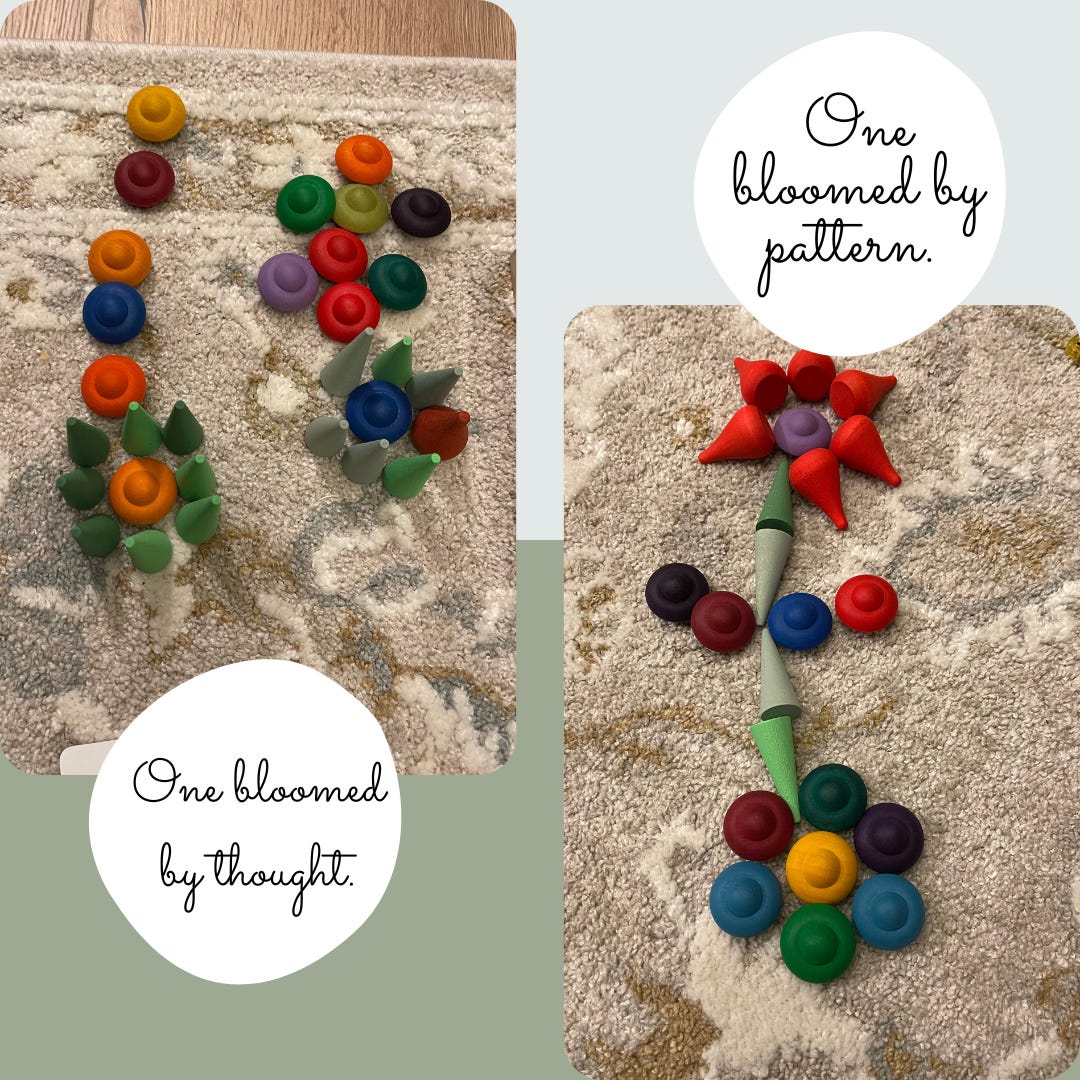
And that, to me, is the difference between compliance and thinking.
Mine looked more correct. His looked more alive.
If I only valued neat replication, I could easily say mine was better and end the story there. But that would miss the more important thing happening underneath. He was not just copying a sample. He was making decisions. He was interpreting. He was entering the task with his own mind.
A child who copies perfectly may be showing attention. That matters. But a child who transforms the idea may be showing something else too: independent thought, pattern recognition, symbolic understanding, willingness to depart from the template, confidence to make choices without needing exact approval.
That is not failing the task. That is engaging with it.
Obedience can hide the deeper question
The risk is not that obedience is bad. The risk is that obedience is visible, so adults overvalue it.
It is easy to notice the child who sits properly.
It is harder to notice whether that child is building judgment.
It is easy to praise the child who copies the model exactly.
It is harder to ask whether that child is learning how to originate, test, revise, and imagine.
It is easy to feel successful when a child gives the expected answer.
It is harder to ask whether the child still trusts their own questions.
This is why I get uneasy when parenting gets reduced to behavior management. Behavior matters, of course. A family cannot function if everybody is feral by 7:15 a.m. Boundaries matter. Manners matter. Safety matters. A child cannot simply do whatever they feel in the name of freedom and “self-expression.” That is not deep parenting. That is abdication dressed up as philosophy.
But behavior is the outer layer.
Thinking is the deeper layer.
And if we keep rewarding the outer layer without protecting the deeper one, we may end up with children who know how to perform well and please adults, but are less practiced in forming an internal compass.
Respect is not the same as submission
This is where I think many conversations go wrong.
The moment you question obedience as the highest goal, people assume you are arguing for chaos. That children should negotiate every instruction like tiny union leaders with snacks in their pockets.
No.
Children need boundaries. They need to learn timing, self-control, social awareness, and responsibility. They need to hear no. They need to respect other people’s bodies, space, energy, and needs.
But there is a difference between teaching respect and teaching submission.
Respect says:
You are allowed to have thoughts, questions, feelings, and ideas. You still need to live with other people.Submission says:
Your highest job is to comply quickly and make authority comfortable.
That second model may produce a very manageable child.
It does not necessarily produce a strong thinker.
And in the AI era, that is a problem.
Why this matters even more now
We are raising children into a world where information is cheap, answers are instant, and confidence can be generated on demand.
Children will grow up around systems that sound certain. They will be shaped by recommendation algorithms, persuasive interfaces, polished content, peer imitation, and AI tools that can produce fluent nonsense in seconds.
In that kind of world, passive obedience is not protection.
A child who has only learned to absorb and repeat will be far more vulnerable than a child who has practiced asking, “Does this make sense?” A child who has only learned to please authority will be easier for every future authority to shape.
That is why I care so much about raising a thinker, not just a follower.
Not because I want a child who resists everything. That would be exhausting and frankly, terrible company.
But because I want a child who can pause before copying the crowd. A child who can listen without surrendering judgment. A child who can cooperate without outsourcing their mind.
Even praise can train the wrong thing
This is the subtle part.
Sometimes the problem is not correction. It is praise.
We say “good job” to the child who stayed quiet. To the child who coloured inside the lines. To the child who copied the sample. To the child who answered quickly. To the child who did not interrupt with their weird thought at the wrong moment.
Over time, children pick up the pattern. They learn which version of themselves gets warmth.
And some children become extremely skilled at being liked.
Less skilled at being mentally alive.
That trade-off may not show up when they are three. It may not even show up when they are eight. But later it matters. It matters when they are under peer pressure. It matters when a teacher is wrong. It matters when an online trend is stupid. It matters when a system sounds convincing but is shallow. It matters when everyone around them is copying, and they need enough inner structure to think for themselves.
What I want instead
I do not want a child who is merely easy.
I want a child who can be respectful without becoming passive.
I want a child who can listen and still question.
I want a child who can follow a direction when needed, but also know when something deserves a second look.
I want a child who can play beyond the template, speak beyond the script, and think beyond the obvious answer.
That kind of child will not always look the neatest in the room.
He may ask too many questions. He may use the toy differently. He may answer sideways. He may complicate the tidy adult picture of what a “good” child looks like.
But perhaps that is not a flaw.
Perhaps that is evidence of a mind at work.
The harder metric
It is easy to ask: Is my child well-behaved?
The harder question is: What kind of mind is being formed underneath that behavior?
Are we raising children who only know how to comply?
Or children who know how to notice, question, imagine, and judge?
Because those children may look similar for a moment. But they will not be equally prepared for the future.
A well-behaved child may be a thinking child.
But not necessarily.
And if we are not careful, we may spend so much time rewarding the appearance of ease that we flatten the very qualities our children will need most later.
Obedience photographs well.
Thinking does not always.
That does not make it less valuable. It may make it more.
If this piece stayed with you, there is more here for parents trying to raise children who can think for themselves, not just fit the mould.


Love this. We can learn so much from children if we place aside our expectations sometimes and just let them create and explore.
I’ve been writing a similar-minded post. 😆🙌🏻